One of the first questions every homeowner asks is, “How big should my solar system be?” A system that is too small leaves you with high bills; one that is too large may exceed what your roof, sanctioned load or net-metering rules allow. The good news is that you can get a reliable first estimate from your own electricity bills.
1. Start with your electricity consumption
Collect your bills for the last 12 months and note the units (kWh) consumed each month. Consumption in Rajasthan usually peaks in summer because of coolers and air conditioners, so a full year gives a fair average.
- Add the 12 monthly units and divide by 12 to get average monthly units.
- Divide by 30 to get average daily units.
2. Convert units into system size
A rooftop system in a sunny region like Rajasthan typically produces around 4 to 5 units per kilowatt per day on average across the year, depending on orientation, tilt, shading, dust and temperature. Your installer will use local data for an exact figure, but the rule of thumb works for a first estimate:
System size (kW) ≈ average daily units ÷ daily units per kW
For example, a home using about 300 units a month uses about 10 units a day, which points to a system of roughly 2 to 3 kW.
3. Check your roof space
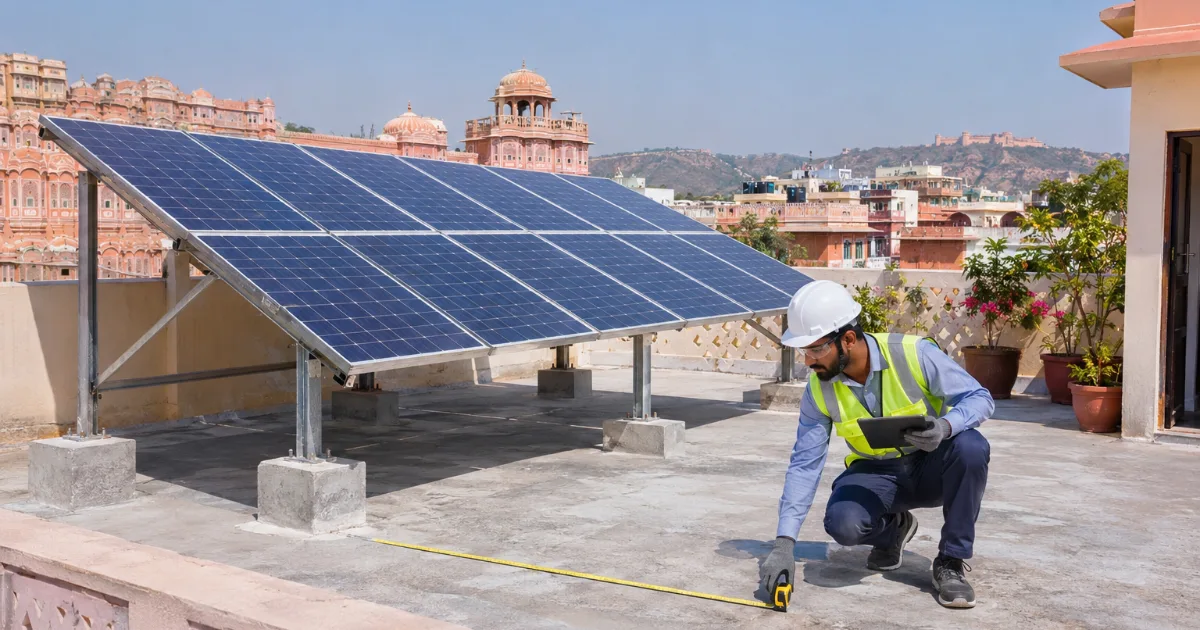
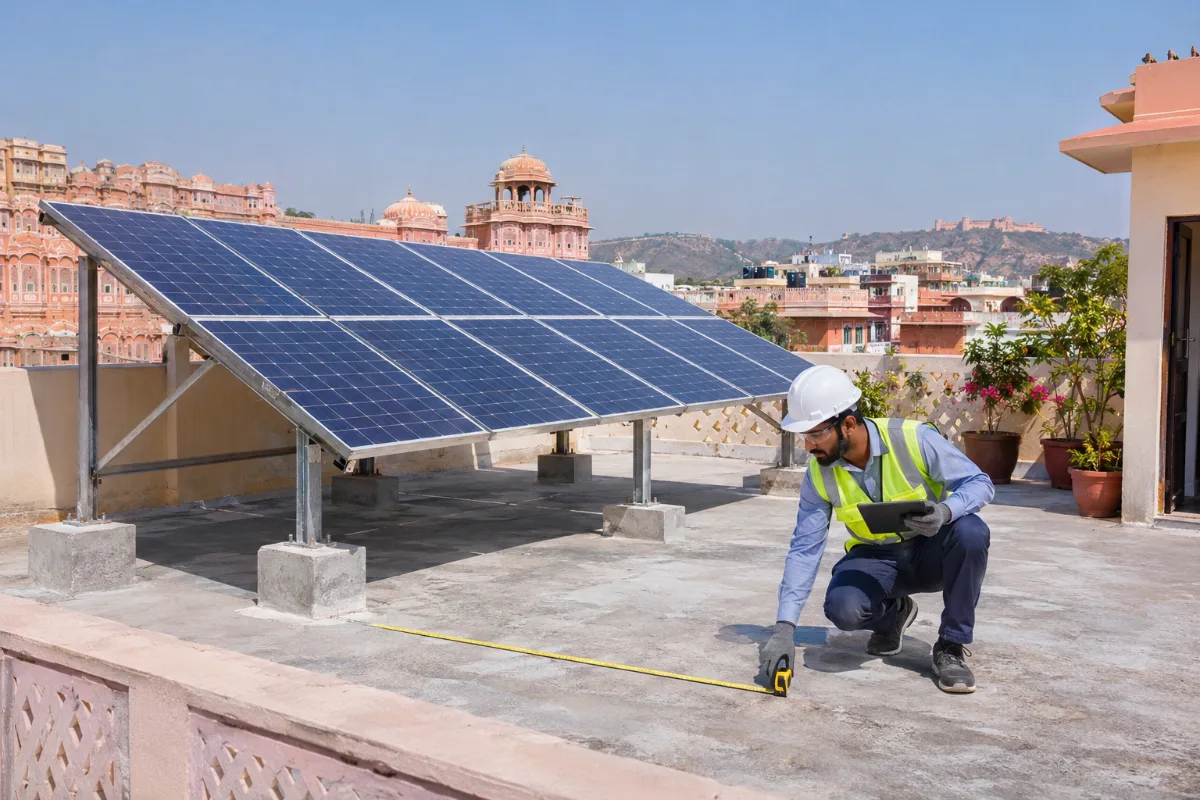
Each kilowatt of modern panels needs a certain amount of shadow-free roof area, which depends on panel wattage and how the structure is laid out. Water tanks, staircases, parapet walls and nearby trees cast shadows that change with the season, so a site survey should check shading at different times of the day.
4. Sanctioned load and net-metering rules
The capacity you can connect is usually linked to your sanctioned load and the rules of your DISCOM. If your planned system is larger than your sanctioned load, you may need to apply for a load increase first. Our step-by-step guide to the rooftop solar net-metering process in Rajasthan explains the paperwork.
5. Think about future needs
- Planning an electric vehicle, an extra air conditioner or an induction cooktop? Your consumption will rise.
- Leave space on the roof or choose an inverter with some headroom so you can add panels later.
- If you face frequent power cuts, consider a hybrid system with a small battery for essential loads.
6. Subsidy and budget
Central and state schemes for residential rooftop solar can reduce the upfront cost for eligible homes. The rules, subsidy amounts and approved vendors are set by the scheme, so always check the current official guidelines. Read our explainer on the PM Surya Ghar rooftop solar subsidy in Jaipur. For the balance cost, many families use a loan; ATTPL Finance can explain the options.
7. A simple worked example
Suppose a family in Jaipur used 4,200 units in the past year. That is about 350 units a month, or roughly 11 to 12 units a day. Using the rule of thumb above, a system of about 2.5 to 3 kW would cover most of their daytime and net-metered needs. If the family plans to add an air conditioner next summer, they might choose about 3.5 kW, provided the roof space and sanctioned load allow it.
A site survey will then fine-tune this figure based on actual shading, roof orientation and the structure. Treat any online calculator, including this rule of thumb, as a starting point rather than a final design.
8. Questions to ask your installer
- How did you calculate the system size, and what generation do you expect each year?
- Which panels and inverter will be used, and are they on the approved lists for the subsidy scheme?
- Who will handle the DISCOM application and net-meter installation?
- What warranty and after-sales service do you provide?
Frequently asked questions
Can solar bring my electricity bill to zero?
It can reduce it substantially. Fixed charges usually remain, and the final bill depends on your consumption, system size and the net-metering rules.
Is a bigger system always better?
Not always. The size should match your consumption, roof space and the capacity allowed by your DISCOM. Extra capacity beyond what you can use or export may not pay back.
How long does a site survey take?
A typical home survey takes about an hour: checking the roof, shading, structure and the electrical connection point.
Get an accurate size for your home. Book a free site survey with ATTPL Solar.